The Approach
Not a conversion. Not a rehab. Purpose built.
There's a fundamental difference between a home that was designed for short-term rental and one that was retrofitted into it. We build the first kind — from the ground up, around a framework of three interconnected priorities.
The Problem With Retrofits
Most vacation rentals weren't built for vacation rental.
Walk through a typical vacation rental property — one that started as a family home or a condo unit — and the compromises become visible within minutes.
The kitchen is closed off from the living space, so the group never gathers in one place. The third bedroom is a converted office with a closet-sized bathroom. The laundry is in the garage. The pool deck gets full sun all afternoon with no shade structure. The entry sequence dumps guests straight into the living room with no drop zone for luggage.
None of these are design flaws in a home. They're normal, functional choices — for a family that lives there year-round. But for a vacation rental that turns over every three to seven days with new groups of 8, 10, 12 people? Every one of those choices creates friction — in the guest experience, in the cleaning workflow, in the reviews, and ultimately in the returns.
The Purpose-Built Difference
Designed from the ground up for short-term rental performance.
A purpose-built property starts with a different question. Not "how do we build a nice home?" but "what does a high-performing vacation rental actually need?" The answer drives every decision that follows.
Guest experience design
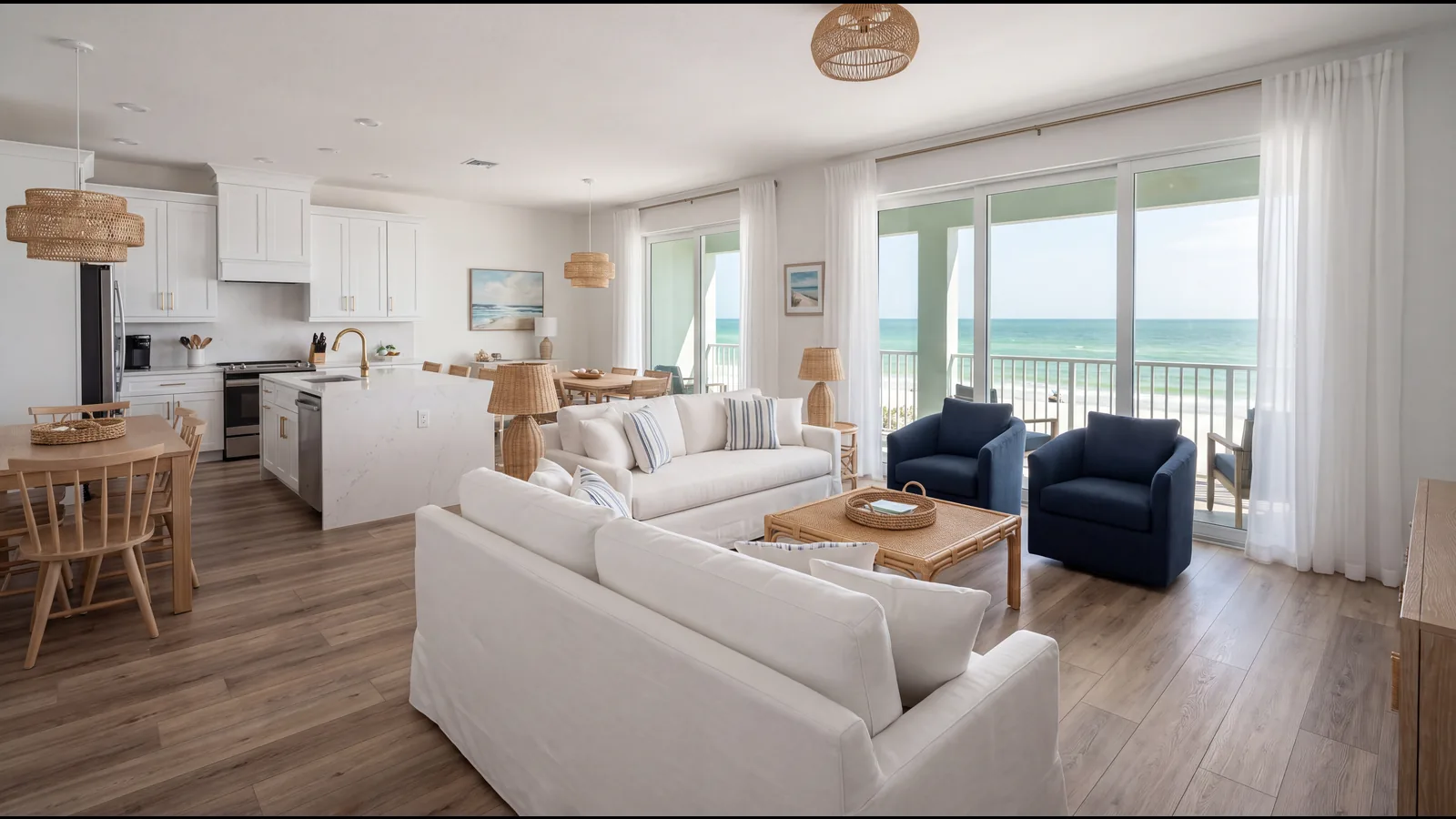
An open-plan great room that connects kitchen, dining, and living into one social space. Bedroom configurations that match real booking patterns — king primaries, bunk rooms for kids, flexible spaces for multi-family groups. Outdoor living treated as additional square footage: covered dining, shade structures, pool layouts designed for groups.
Operational design
Laundry located adjacent to the cleaning supply closet, not at the far end of the hall. Finishes selected for durability under 52 turnovers a year — commercial-grade flooring, quartz surfaces, performance fabrics. Access panels that make maintenance fast. Smart-home systems that streamline check-in and remote management.
Return-driven design
Every square foot justified by revenue potential. Room counts matched to market demand patterns — not builder convention. Finishes and amenities aligned with what guests in this market actually search for and pay a premium to book. Energy efficiency, insurance optimization, and durability built in from day one.
Why It Matters
Better design. Better reviews. Better returns.
When a property is designed for the way guests actually use it, the experience feels effortless. Five-star reviews aren't the result of luck — they're the result of eliminating friction before the first guest ever walks through the door.
When a property is designed for the way it's cleaned and maintained, operational costs drop, turnover time shrinks, and maintenance surprises become rare. When every design decision is connected to return on investment, the numbers work from day one — not after three years of "learning the property."
Higher satisfaction
Designed experiences earn better reviews — which drive occupancy.
Lower operating costs
Efficient layouts reduce turnover time and maintenance overhead.
Stronger returns
Data-driven design outperforms retrofitted properties, season after season.
The Framework
Three pillars. One outcome.
Every purpose-built property is engineered around three interconnected priorities: Guest Experience, Operational Efficiency, and Investor ROI. No pillar stands alone — each reinforces the other two.
Pillar 01 — Guest Experience
Design that earns 5-star reviews.
A great guest review isn't a mystery. It's the result of a thousand small design decisions that add up to an effortless, memorable stay — arrival that sets the tone, social space that keeps the group together, bedrooms designed for real booking groups, and outdoor living treated as primary space.
- Open-plan great room connecting kitchen, dining, and living into one continuous social space
- Primary suites positioned for privacy with dedicated outdoor access
- Bunk rooms designed for kids — durable, fun, and away from adult zones
- Covered outdoor dining with ceiling fans, lighting, and direct kitchen access
- Pool positioned for all-day sun with adjacent shade structure
- Turnover-optimized layout — laundry and cleaning storage integrated into the floor plan
- Commercial-grade luxury vinyl plank flooring that handles sand, water, and 52 turnovers a year
- Quartz surfaces and performance upholstery that resist stains and clean easily
- Access panels for HVAC, plumbing, and electrical — not buried behind drywall
- Elevated, impact-rated construction to post-Ian codes and FEMA CRS Class 5 compliance
Pillar 02 — Operational Efficiency
Design that reduces the cost of every turnover.
The difference between a property that's profitable and one that's marginal often comes down to operations — cleaning time, maintenance access, durability under heavy use. These aren't afterthoughts; they're design inputs. A property built to withstand coastal conditions costs less to insure and less to maintain.
Pillar 03 — Investor ROI
Design that earns its place on the balance sheet.
Every design decision in a purpose-built property connects to return on investment. We don't build features because they look good in a brochure — we build features because the data shows guests search for them, book because of them, and pay a premium to have them.
Room configuration is matched to booking-platform demand data. Every amenity is evaluated against its impact on booking conversion and average daily rate. Efficient HVAC zoning, LED lighting, smart thermostats, and tankless water heaters drop straight to the bottom line — and resilience, from impact-rated construction to FEMA compliance, protects long-term returns.
- Revenue-driven room configuration matched to Fort Myers Beach demand data
- Amenity ROI analysis — pool as the #1 search filter, not a theater room that costs a bedroom
- Energy and operating-cost modeling that compounds over the life of the property
- Resilience as ROI — impact-rated, elevated, FEMA-compliant construction
The Interconnection
Guest Experience drives reviews, which drive occupancy. Operational Efficiency reduces cost, which increases margin. ROI justifies the design investment — which improves the experience. The pillars aren't separate priorities. They're a closed loop.
Continue
The market that makes it all work